

I got some news this week: The Dream Press (name redacted) that I’d been hoping would consider my memoir manuscript followed up with me. Actually, one person there—an editor—who I met at Prairie Lights in April and who offered to personally read my full manuscript (a generous offer that still boggles my mind) got back to me. She wrote a lovely, thoughtful email that thanked me for sharing my work and for having such patience over these past several months. She couldn’t accept my book for publication—which wasn’t surprising—but what was surprising: she actually recommended another press to reach out to next. I mean, who does that? Very few in the publishing industry, I’m guessing. I reposted her email in my social media (with names redacted) and wrote that this was “a good reminder that the literary world is small and made up of mostly good, enthusiastic people who are rooting for writers regardless of whether they sign with them or not.”
I meant every word. But, also…this sucks. If you’re a fellow writer (or any other creative), I’m sure you understand how hard this sucks. As Barry Keoghan’s character Dominic Kearney says in The Banshees of Inisherin:
Rejection isn’t anything new, of course. I’ve been rejected by plenty of writing contests, agents, residencies, scholarships, etc. I thought I was okay, but this morning, when I really allowed myself to think about it and feel my feelings (as we say in recovery work), I cried. Like, a lot.
Baffled by this, I tried to examine my reaction objectively. Am I merely tired from a busy work schedule? (I am, but there’s more than just that.) Am I feeling especially rejected this time? (Not especially, no…I mean, she was so NICE!)
…Is this particular rejection hurting more because it was the first time someone in the publishing industry acknowledged my personal story and said that parts of it resonated with her? (But only parts?) Hm.
I thought more about what my memoir is: a story of trauma (the end of my abusive first marriage), hard-to-pin-down-loss (the loss of not just a marriage but also an identity as a married person—an identity that I thought I was supposed to have), and a struggle to create healthier relationships and personal boundaries in a city of 22 million people [Beijing]. Then, I started looking more into attachment styles—something my therapist has been bringing up more often in our sessions—and I realized today that my memoir is basically a condensed history of my anxious attachment.
Consider, if you will, this summary of anxious attachment from the Cleveland Clinic:
What is the anxious attachment style?
An anxious attachment style is an insecure attachment style that’s characterized by a strong desire for meaningful relationships, a fear of abandonment and rejection, and a high need for reassurance and support. It’s also known as preoccupied attachment or anxious-ambivalent attachment because of the combined elements of anxiety, low self-esteem, and an intense need for love and affection.
Causes
As one of the four main pillars in attachment theory, the anxious attachment style is thought to form from inconsistent or unpredictable caregiving during childhood…Other potential causes for an anxious attachment style include:
Getting ghosted
Dealing with ambiguous loss (having no closure when a short- or long-term relationship ends)
Harboring resentment from past relationships
Trauma
Signs
You may have an anxious attachment style if you’re:
Preoccupied or fixated on your partner’s needs
Prioritizing your partner’s needs over your own
Experiencing fear of rejection or abandonment
Questioning your self-worth
Having a strong need for validation or reassurance that you are loved
Experiencing patterns of heightened anxiety or worry
Experiencing mistrust or jealousy in your relationships
Having difficulty with healthy boundaries
Having difficulty expressing or understanding your own emotions
I bolded the items in the above “Causes” and “Signs” list that especially resonated with me, but really, I identify on some level with each of these signifiers. And I’ve enacted or engaged with all of them at least once.
The more I think about this, the closer I get to a few new realizations:
The simple, professional rejection I received this week triggered my fear of rejection and abandonment because it wasn’t just a single essay getting rejected, but my entire first book—which feels, however illogically, like a rejection of me.
I probably need to revise my manuscript a bit more (ugggggggh) to emphasize my loss of identity in the beginning of the book (or at least find a way to emp hasize this point in my query letters and nonfiction proposal). This seems to be an important key to unlock some deeper emotions. (What happens when someone loses who they thought they were? What do they gain—and lose—when they attempt to change their identity from Married Person to Divorced Expat?)
I probably also need to interrogate my feelings over one of the central relationships in my memoir and question them…which will likely lead to more revision.
In my most recent memoir draft, I focused on adding as much scene work and context about my ex-husband as I could…and let me tell you, this was exhausting. I hated bringing him back, so to speak, into my daily consciousness…but I knew I had to do the work so readers could understand what I was escaping from. This paid off, I think, but I might have made another relationship in the book a little too shiny and neat-looking to compensate.
There’s another “major male” in my book (which I hate to admit—if my life were a movie, it definitely wouldn’t pass the Bechdel Test—but hey, it happened). I don’t talk about him1 much these days since we were only ever friends, but I loved this person dearly and felt I could say anything to him. About a year into our friendship, I called him my platonic soulmate, and he enthusiastically accepted the label. We were both teachers at the international school I worked for in Beijing, and we quickly bonded over our shared love of quirky self-help books, strong coffee, and long conversations. We met up pretty much every weekend to talk for hours over our latest read, and up to that point, our friendship was one of the healthiest relationships I’d ever had. I thought he’d be in my life forever.
This doesn’t really get explained in the current version of my book, but maybe it should: We’re no longer friends. He ghosted me during the pandemic (blocked me, actually—no explanation why), and I haven’t been able to reach him since. See Item #1 of the “Causes” of anxious attachment above and pair it with Items #2 and #4 (ambiguous loss and trauma), and you’ll probably see why I still struggle as a nearly-forty-year-old with relationships of any shape or size.
To say this devastated me is a profound understatement. Unfortunately, my Midwest culture doesn’t have any information on how to process the loss of an intimate friendship other than: “Hey, that sucked. Maybe get closer to your other friends?”
I haven’t thought of this person in awhile, but perhaps I should—as an inquisitive writer. I suspect my intense and slightly delayed reaction to the most recent rejection of my manuscript has something to do with an unacknowledged insecurity I have around it. Unlike the insecurity I’ve often felt toward loved ones—which often tends to be exaggerated and unwarranted due to my past trauma—insecurity about a writing project usually means something is missing, and I’m the only one who can figure out what that is. Maybe this is my sign that the book still isn’t ready, as much as I want it to be.
Maybe I actually need to get mad at my lost friend and admit that what he did was unacceptable. And take a more thorough inventory of the role I played in that relationship.
I tried another little experiment with my Google Photos account today and typed “anxious” into the search bar, just to see what it would generate. There were a lot of random photos: selfies of me from different years trying to look happy or sexy, depending on each picture’s intended audience; weirdly, several pictures of my cat and friends’ cats, and a handful of pictures I hadn’t seen in awhile.
In May of 2020, my lost friend spent an entire day in my last Beijing apartment (after I hadn’t physically been there for about four months) to stuff a suitcase with as much of my personal belongings as he could, and we devised a quick system of communication on WeChat over a span of several hours: He would take pictures of piles of my stuff, and I would draw Xs over things to toss and circle or “heart” things to keep and put in the suitcase. This one especially struck me for its context:
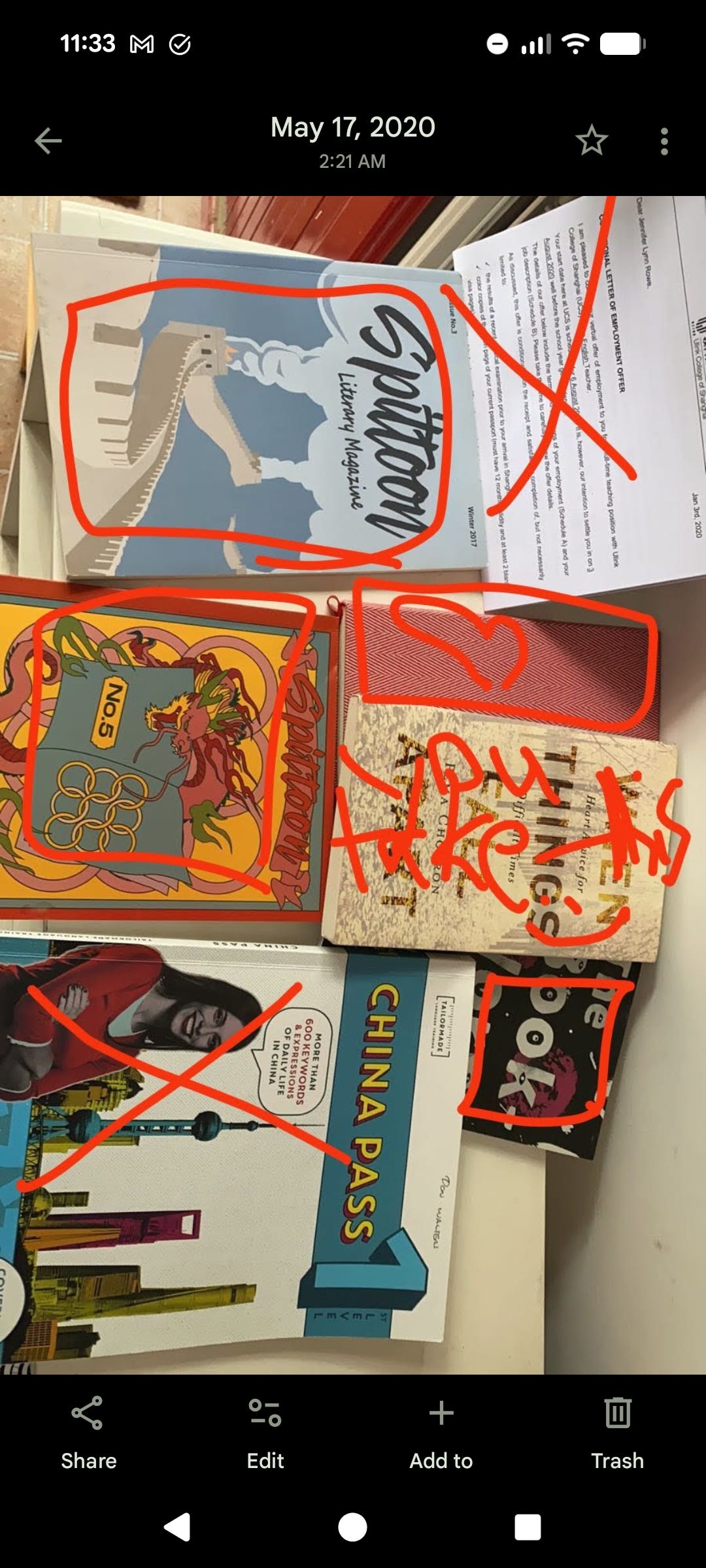
Image description: A pile of books: China Pass, a beginners’ Mandarin language book (which I crossed out), two issues of Spittoon, Beijing’s only bilingual lit mag (which I circled to keep), a red journal (which I of course wanted to keep—it has a heart drawn over it), and a copy of Pema Chodron’s When Things Fall Apart. It’s hard to read, but I scribbled with my phone-pen over it: “You take this. :)”
I gave him my copy of When Things Fall Apart, the same copy I’d read at least twice during my divorce and still felt I had to take with me to Beijing. I thought that book would help him…maybe it did or maybe it will, if he hasn’t read it yet. Maybe not. But now, I’m strangely pissed that I gave him this book and never got to talk to him about it. It felt like I was giving a piece of myself away when I told him he could keep it, but I thought I didn’t need that piece anymore, that it could be safe with him.
Then, he ghosted me.
I think I just realized why I’ve been so resistant to looking at my manuscript again…it’s still missing something. And I might know what, now.
Back Desk Questions:
What’s your attachment style, and how does it influence you as a writer/creative?
How do you rally yourself to return to a project you’re sick of seeing (but also want to get right for sharing with the world)?
What’s a book you’ve given away but now wish you’d kept for yourself?
I’m choosing not to name him here in case I change his name in my book later on…I’ve been using his real name in my manuscript so far.