

We’re about a week away from the winter solstice, and I can feel it in my body: a desire to slow down, get quiet. I got to do a bit of that last night since a fresh blanket of snow made my Prairie Lights shift especially still. The bookstore was basically empty for our last two hours in business, and I got to finish Patti Smith’s new memoir, Bread of Angels, uninterrupted. I think she’d be pleased if she knew I finished reading her book while snow fell quietly outside and the occasional drunk college student shouted in the deserted street.
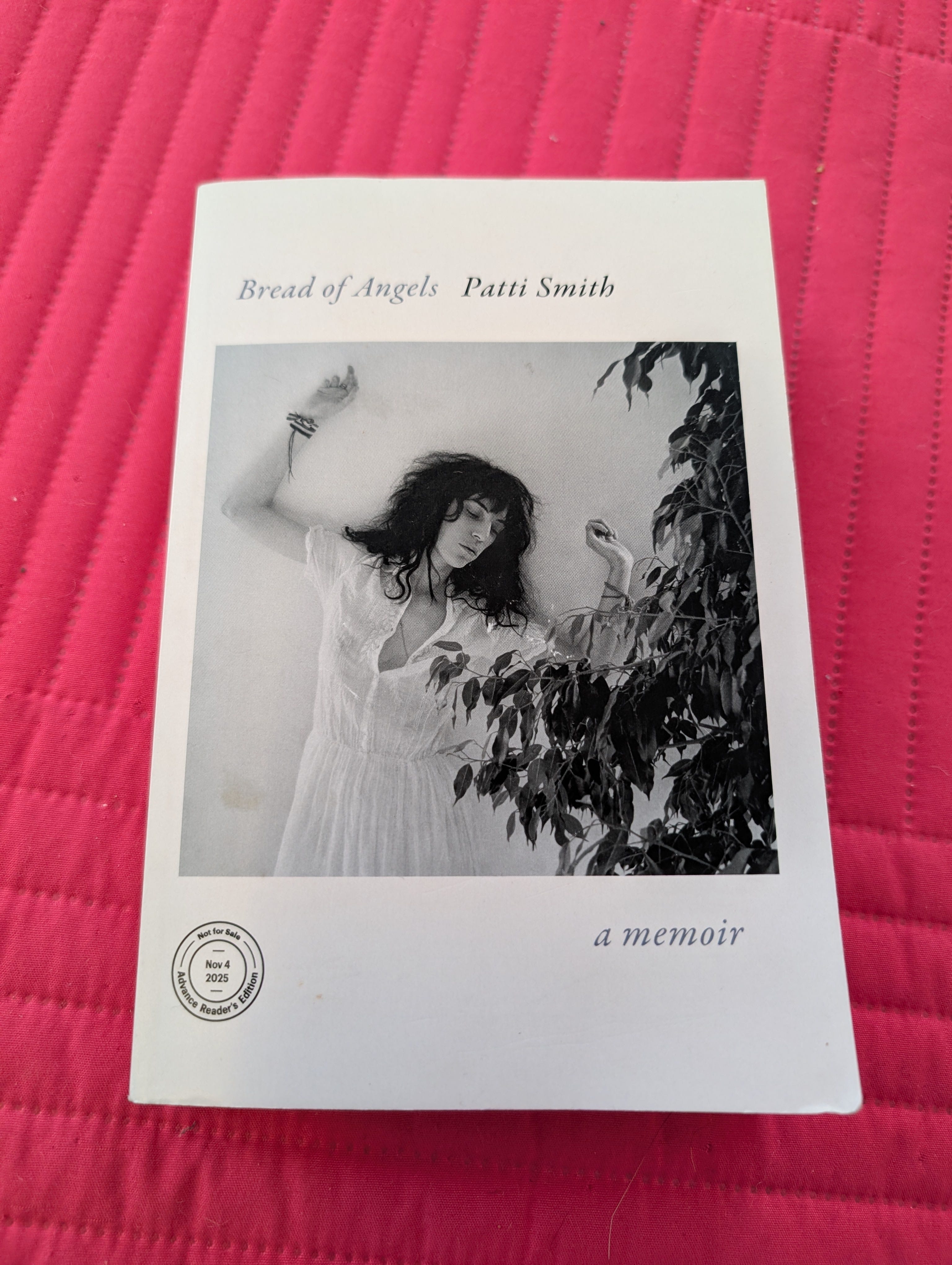
Image description: A photo of an ARC of Patti Smith’s Bread of Angels, which rests on my pink bedcover and is illuminated by soft lamplight.
If you’ve already read Just Kids, her National Book Award-winning memoir, then you know Smith can write. Bread of Angels contains her same magical introspection and detailed sentences, and it’s a pleasure to read from beginning to end. It begins with her earliest memories from childhood and goes all the way up to the present day, and though this is a complaint I have about pretty much every celebrity memoir (that they’re not memoirs at all but rather autobiographies), I’m willing to give Smith a pass on this false advertising. I get it, “autobiography” just doesn’t sound sexy enough, and she’s lived a long, fascinating life. (Just Kids is a true memoir because it focuses on a specific time of her life, which was her relationship with Robert Mapplethorpe.)
Without giving too much away, here’s one astounding example of how incredible her life has been: Near the end of the book, she writes of a memory from 1995 in which she got to meet the Dalai Lama during the International Peace Foundation in Berlin. They had some time to talk, and she told him the story of how she insisted on doing a presentation about Tibet for history class in elementary school (which appears near the beginning of the book). Her teacher had chided her on this choice, claiming nothing interesting had happened in that small country for decades, but just days before her presentation, Tibet was invaded by China, and the young Dalai Lama had to flee into exile. As a child, Smith believed she was somehow responsible for this tragedy because she had wished something exciting would happen in Tibet. She said all of this to His Holiness, and then, he took her hand and said, “It was not your fault.”
I mean, what? Can you imagine having such a profound experience, not just in meeting the Dalai Lama but then having him personally forgive your child self for something you thought you did?! This blew my mind, and I only read her account of it…I can’t imagine what it must have felt like.
The real magic of this book is Smith’s dedication to and love for her child self. She makes clear that this is the version of herself that taught her how to be an artist, and she manages to call back this persona throughout each major milestone: as a rock star (also badass), as a new wife and mother, and later, as a person with profound accumulated loss who resolves to continue moving through the world. She uses a charming poetic phrase as metaphor for her child self— “rebel hump,” which she explains in the Prelude came to her while writing:
“What do these words mean, asks the pen. I don’t know, replies the wrist. These are the words forming and the writer, stationed at Dolina Charlotty, in a valley in northern Poland, will decide later” (p. 3).
I felt as I was reading Bread of Angels that Smith was inviting me into her life, but she also wasn’t overly concerned with making sure I understood every detail perfectly. Certain sections of the book feel slower than others because they’re weighed down in lengthy metaphor, but I suspect this was out of a concern for privacy for those she’s lost (especially regarding her late husband Fred Sonic Smith). This bothered me initially, but by the end of the book I accepted her preferred style and just went with it. Besides, she didn’t write this book for me; she wrote it for her child self, and we’re just lucky to be along for the ride.
For me, the most enjoyable chapter is the last. “Vagabondia” is split into six sections and is just what it sounds like: an existence as a wandering artist, thinking thoughts and writing them down when she can. I underlined the most sentences here, including these gems:
“I order another coffee, more people, less people, making little impact on my productivity; somehow the day disappears” (p. 244).
“That is something I can do, sit quietly, go elsewhere and not return empty-handed” (p. 248).
“The artist seeks paradise in life, he seeks what must not be sought” (p. 261).
“Shedding is one of life’s most difficult tasks. One by one we apportion our talismans. But I will keep my wedding ring and my children’s love” (p. 266).
…And my personal favorite, which is on the same page:
“We plunge back into the abyss we labored to exit and find ourselves within another turn of the wheel. And then having found the fortitude to do so, we begin the excruciating yet exquisite process of letting go.”
I had a therapy session this morning, and I told my therapist, who was asking me how I might find greater fulfillment in my life, that Patti Smith seemed to offer wisdom on this goal, with or without certain privileges. Bread of Angels describes how she struggled with poverty and illness for decades (both as a child and later as a young adult), though she never lost her intense imagination or ability to be inspired. As long as she surrounded herself with books to read and other artists to learn from, she was fulfilled. It’s a valuable lesson for anyone, and I understand now why she says that “paradise in life” is “what must not be sought.” It’s impractical, this supposed paradise…and yet, it’s what makes life worth living.
If you’re like me and currently feeling a little depressed, a little stuck, or a little less than fulfilled, I think you’ll find something restorative in Bread of Angels. It came at the right time for me.
And speaking of something restorative: This week I found out I’d been selected as one of this year’s 600 booksellers receiving the James Patterson Bookstore Holiday Bonus! My colleague Kathleen confessed she nominated me when I told her, and I gave her a big hug. I was deeply touched that she thought of me for this $500 prize, and it’s reminded me to keep the gratitude going by nominating one of my fellow booksellers next year. How many people get to say their colleagues do such kind, thoughtful things for them?
Not many, I suspect.
As this year wraps up, I’m reminding myself that fulfillment or happiness, whatever you want to call it, is a state of mind. I have to work at being happy; no one else can do that for me. And Patti Smith has shown me what a life involving that kind of work can look like.
Please lend it to me!! I love her!
An excellent sharing of your experience, Jenny!